
Bora Bora or Fiji: Which South Pacific Escape Is Right for You?
Fiji and Bora Bora are the two names that come up most often when American travelers start comparing South Pacific honeymoons and bucket-list trips. Both deliver turquoise water and world-class resorts, but the experience, the cost, and the kind of trip each one rewards are genuinely different. Here’s how they actually compare.
Quick Comparison
| Category | Bora Bora | Fiji |
|---|---|---|
| Estimated Budget | $4,000 – $8,000 / person | $3,000 – $6,000 / person |
| Flight Time from the US | 13-16 hours door to door, with connections | 10-11 hours nonstop from the West Coast |
| Overwater Bungalows | The category’s birthplace — the largest, most refined collection anywhere | A handful of properties — real, but a fraction of Bora Bora’s offering |
| Diving & Marine Life | Excellent lagoon snorkeling; less known for deep diving | World-class — the self-proclaimed “soft coral capital of the world” |
| Vibe | Exclusive, contemplative, refined | Warm, communal, welcoming |
| Best For | Honeymoons, anniversaries, the classic overwater bungalow fantasy | Value-driven trips, longer multi-island stays, first-time South Pacific travelers |
Budget: Fiji Usually Costs Less, But Not Always Where You’d Expect
On paper, Fiji is the more affordable of the two — and for most travelers it is. But the gap isn’t really about airfare. Flights to Fiji from the West Coast (roughly 10 to 11 hours nonstop to Nadi) aren’t necessarily cheaper than the roughly 8-hour flight to Papeete, and during peak season either route can get expensive. The real difference shows up once you land: accommodation and daily dining.
Bora Bora’s hotel scene is dominated by ultra-premium overwater bungalows, and that category carries a steep nightly premium almost everywhere on the island. Meals, drinks, and excursions run high too, since nearly everything is shipped or flown in. A comfortable Bora Bora stay typically runs $4,000 to $8,000 per person.
Fiji offers a much wider spread of options, from all-inclusive bure resorts with meals built into the rate to more moderately priced beachfront properties, without giving up the tropical luxury feel. A comfortable Fiji trip typically lands between $3,000 and $6,000 per person, and it’s often easier to predict your total spend in advance since more resorts bundle meals and activities into the nightly rate.
If cost is the deciding factor, Fiji is usually the better value. But that gap narrows fast if the specific thing you want is a Bora Bora overwater bungalow — no amount of budget shopping in Fiji gets you the same room.
Getting There: Both Take Real Effort, But the Last Mile Differs
Neither destination is a quick hop. From the US mainland, Bora Bora typically means a flight to Los Angeles or San Francisco, a roughly 8-hour nonstop to Papeete, a domestic flight to Bora Bora’s Motu Mute airport (about 50 minutes), and a boat transfer to your resort — 13 to 16 hours door to door.
Fiji is farther in raw flight time — widebody jets fly nonstop from Los Angeles to Nadi in about 10 to 11 hours — but once you land, the last leg can be quick. Many Mamanuca and Yasawa island resorts are reachable by boat or helicopter within about an hour of touching down, so the total time from landing to lagoon can end up shorter than Bora Bora’s multi-leg routing.
In short: Bora Bora has the shorter international flight, Fiji often has the shorter transfer once you’re there. Total door-to-door time ends up fairly comparable for most itineraries.
Overwater Bungalows: Bora Bora Still Owns the Category
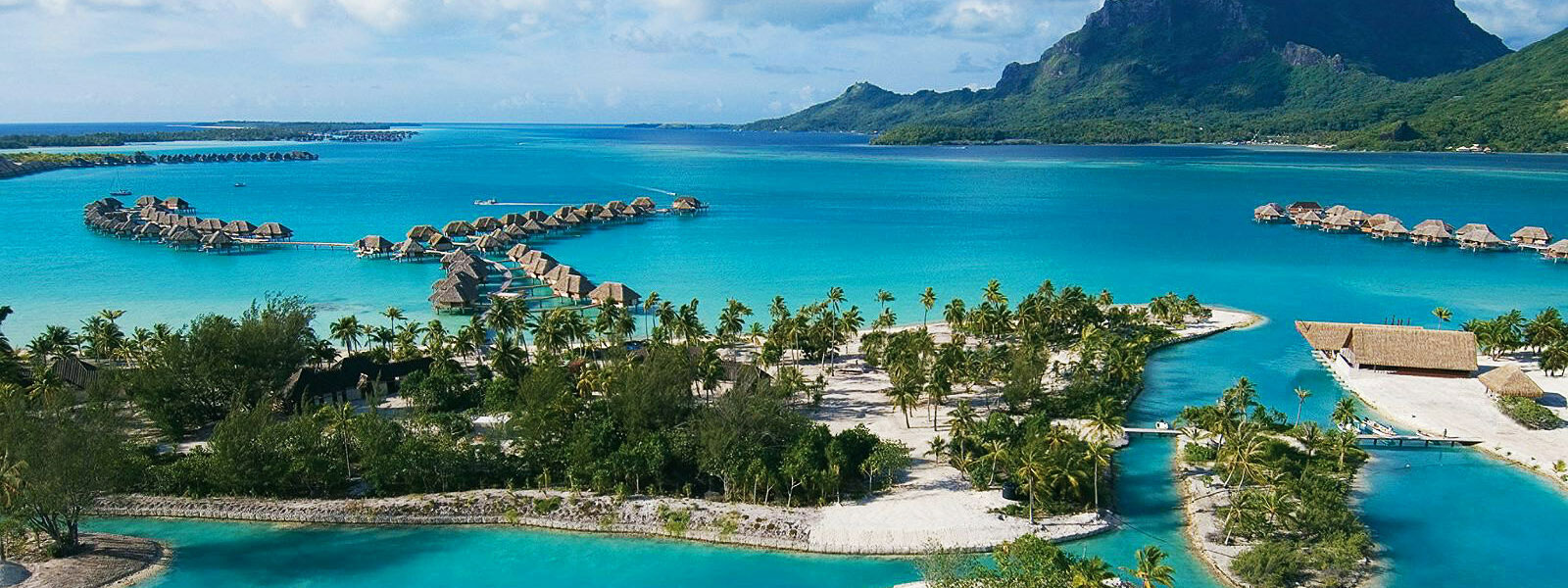
Bora Bora is where the overwater bungalow was essentially invented, at the original Hotel Bora Bora in the 1960s, and the island still has the largest and most refined collection anywhere on Earth — Four Seasons, St. Regis, Conrad, InterContinental, and more, each with its own take on stilted villas over the lagon.
Fiji has real overwater bungalows too, but the category is much smaller there — a handful of resorts across the islands, with most of the accommodation mix leaning toward beachfront and garden bures instead. If waking up over a lagoon is the whole point of the trip, Bora Bora remains the more reliable bet.
Diving and Marine Life: Fiji’s Clear Advantage
Fiji has built its reputation as one of the best diving destinations on Earth, often billed as the soft coral capital of the world. Sites like the Somosomo Strait draw divers specifically for the density and color of the reef life, and most resorts run their own PADI operations with dive sites just minutes away.
Bora Bora’s lagoon is fantastic for snorkeling and shallow encounters — stingrays, blacktip reef sharks, coral gardens you can reach without a tank — but it isn’t primarily a diving destination the way Fiji is. For travelers who dive seriously, Fiji is the stronger pick.
Building a Multi-Island Trip: Two Different Logics
Both destinations reward a multi-island itinerary — they just get you there differently.
Fiji’s islands are clustered close together, mostly within a couple of hours of Nadi, so it’s easy to island-hop even on a relatively short trip. A week can realistically cover two or three islands across the Mamanuca or Yasawa groups without losing much time to transfers.
Bora Bora sits within French Polynesia, which has just as much variety on offer — Moorea’s mountains and bays, Tahaa’s vanilla farms and shared lagoon, the flat coral atolls of the Tuamotus, or the dramatic, rarely visited peaks of the Marquesas. The catch is distance: these archipelagos are spread far apart, so building a real multi-island French Polynesia trip takes more time, typically 10 to 14 nights or more. See our 10-day itinerary or 14-day itinerary for how we build that out.
Short trip with easy island-hopping: Fiji has the edge. Longer trip with room to explore real diversity: French Polynesia holds its own.
Culture, Crowds, and How Protected Each Destination Really Is
Fiji is a well-established, high-volume tourism destination — it welcomed more than 1 million visitors in 2024 alone, a record year, with a mature backpacker circuit, cruise ship calls, and resorts at every price point. That scale brings real upsides: more resort choice, easier logistics, and a tourism economy that’s deeply woven into daily life. Fijian hospitality is famous for a reason — villages welcome visitors, kava ceremonies happen most evenings regardless of where you’re staying, and the staff-to-guest ratio at many resorts means you’re on a first-name basis within a day or two.
French Polynesia operates on a much smaller scale — around 264,000 visitors across the entire territory in 2024, roughly a quarter of Fiji’s numbers. Development is more tightly controlled, many resort motu are leased to a single property rather than shared, and daily life outside the resorts runs on Polynesian and French rhythms rather than a tourism-first economy. The result is a trip that feels more protected and less commercialized — fewer crowds, fewer curated “cultural show” experiences, and a stronger sense that you’re visiting somewhere still largely on its own terms.
Neither approach is better across the board. Fiji’s scale makes it warm, easy, and well-oiled. French Polynesia’s smaller footprint makes it feel more exclusive and untouched.
A French Touch vs Fiji’s Easy, English-Speaking Warmth
French Polynesia is an overseas collectivity of France, and that shows up in small but constant ways: fresh baguettes and pastries at breakfast, wine lists built around French vintages, French spoken alongside Tahitian, and an unhurried, understated elegance to how the resorts run. For American travelers, that French layer adds a genuine sense of visiting somewhere else entirely.
Fiji, by contrast, is instantly comfortable for English speakers — it’s the country’s official language alongside Fijian and Fiji Hindi, so there’s no language barrier to navigate at all. The vibe leans relaxed and easygoing, often summed up locally as “Fiji time.” It’s a different kind of welcoming: less exotic in the day-to-day details, more immediately warm and familiar.
Which One Should You Choose?
Choose Fiji if value matters most, you want to island-hop on a shorter trip, you’re drawn to world-class diving, or you want a warm, communal atmosphere with easy access to local culture.
Choose Bora Bora if the overwater bungalow is non-negotiable, you want the single most photographed lagoon in the world, you’re planning a honeymoon or another milestone trip, or you’d rather build a longer, more varied itinerary across French Polynesia’s islands.
Plenty of travelers eventually do both — Fiji for value and diving, Bora Bora for the once-in-a-lifetime overwater week.
Frequently Asked Questions
Is Fiji cheaper than Bora Bora?
Usually, yes — mainly because of accommodation and dining costs rather than airfare. A comfortable Fiji trip typically runs $3,000 to $6,000 per person, compared to $4,000 to $8,000 for Bora Bora.
Can I combine Bora Bora and Fiji in one trip?
Not easily. There are no direct flights between French Polynesia and Fiji, so combining the two in a single trip means routing back through a hub like Los Angeles or Auckland, which adds significant time and cost. Most travelers choose one destination per trip.
Which has better diving?
Fiji, by a clear margin. It’s globally recognized as one of the best diving destinations on Earth, with warm water, healthy reefs, and dive operators at nearly every resort. Bora Bora’s lagoon is better suited to snorkeling and shallow encounters than serious diving.
Is Fiji more crowded than Bora Bora?
In overall numbers, yes — Fiji welcomes more than 1 million visitors a year, compared to roughly 264,000 across all of French Polynesia. Fiji’s tourism infrastructure is bigger and more developed as a result, while French Polynesia’s smaller scale gives Bora Bora a more protected, less commercialized feel.