
Bora Bora or Hawaii: Which Is Right for Your Trip?
For a lot of American travelers, this is the real fork in the road when planning a tropical getaway. Hawaii is close, familiar, and endlessly flexible. Bora Bora is farther, more exclusive, and delivers a completely different kind of escape. Here’s how the two actually compare.
Quick Comparison
| Category | Bora Bora | Hawaii |
|---|---|---|
| Estimated Budget | $4,000 – $8,000 / person | $2,000 – $4,500 / person |
| Flight Time from the US | 13-16 hours door to door, with connections | 5-11 hours nonstop from most hubs |
| Passport Required | Yes | No — it’s a US state |
| Overwater Bungalows | Abundant — the original and finest in the world | Virtually none |
| Vibe | Exclusive, contemplative, culturally distinct | Familiar, developed, versatile |
| Best For | Honeymoons, anniversaries, a true trip of a lifetime | Families, first-timers, budget-conscious trips, long weekends |
Budget: Hawaii Is the More Affordable Choice
Hawaii is a domestic trip in every sense that matters for your wallet: a domestic flight, US dollars, no exchange rate to think about, and a huge spread of accommodation from budget motels to five-star resorts. That range makes it easy to dial the trip up or down to fit almost any budget. A comfortable Hawaii vacation, flights included, typically runs $2,000 to $4,500 per person.
Bora Bora is structurally more expensive, and it’s not really about markup — it’s geography. Nearly everything on the island, from building materials to imported food, has to be shipped or flown in, and the hotel scene is dominated by luxury resorts with very few budget alternatives. Add the cost of getting there in the first place, and a comfortable stay typically runs $4,000 to $8,000 per person, with the top-tier overwater villas at properties like the Four Seasons or St. Regis pushing well beyond that.
If cost is the deciding factor, Hawaii wins clearly. But Bora Bora is selling something Hawaii can’t really replicate — more on that below.
Getting There: A Short Hop vs. a Real Journey
Hawaii is about as easy as international-feeling travel gets without actually leaving the country. Nonstop flights run from most major US hubs — Los Angeles, San Francisco, Seattle, Denver, even New York — with flight times between 5 and 11 hours depending on where you start. No passport, no customs, no currency exchange. You land and your vacation starts the same day.
Bora Bora asks for more. From the US mainland, the typical routing is a flight to Los Angeles or San Francisco, then a nonstop overnight flight of roughly 8 hours to Papeete, Tahiti, followed by a domestic flight to Bora Bora’s Motu Mute airport (about 50 minutes), and finally a boat transfer to your resort. All in, door to door, you’re looking at 13 to 16 hours of travel, plus a passport and a border crossing into French Polynesia.
That extra effort isn’t a downside so much as part of the experience. Getting to Bora Bora takes real commitment, and for a lot of travelers, that’s exactly what makes arriving feel like such a genuine escape.
Overwater Bungalows: One Destination Basically Invented Them
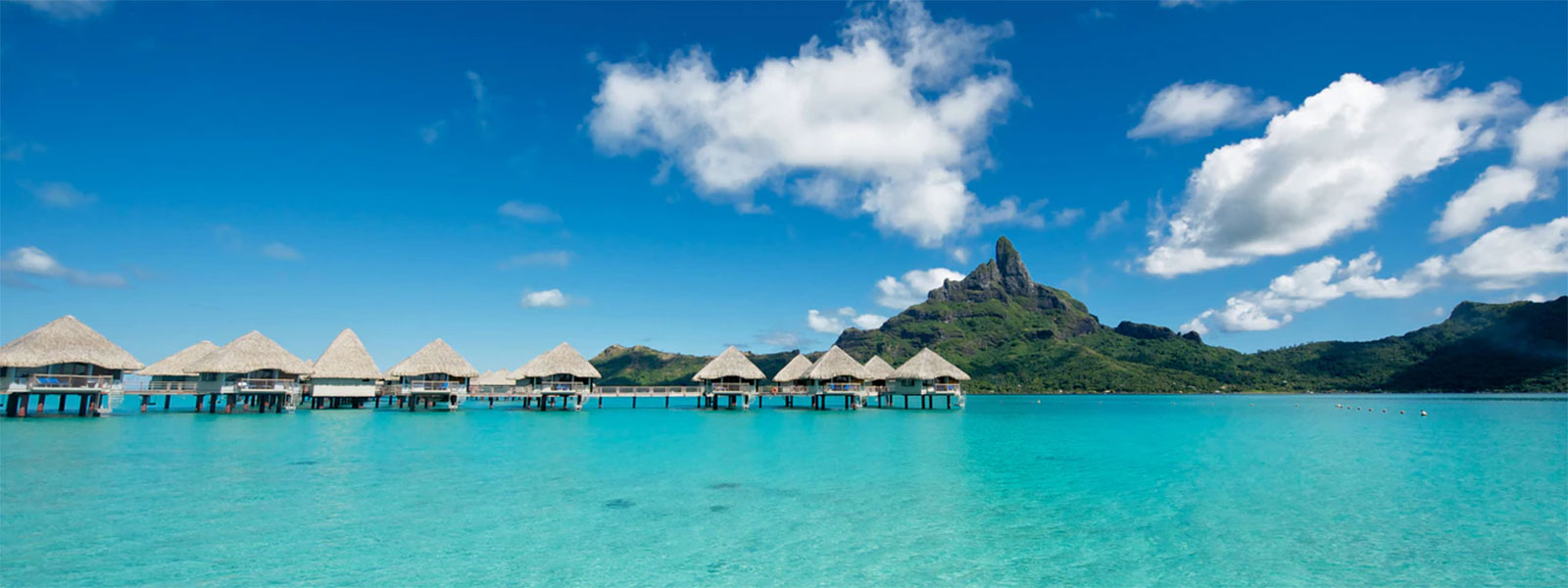
Bora Bora is where the overwater bungalow concept was essentially born, back at the original Hotel Bora Bora in the 1960s, and the island still has arguably the largest and most refined collection of them anywhere on Earth — Four Seasons, St. Regis, Conrad, InterContinental, and more, each with its own take on stilted villas set directly over the lagon. If waking up over turquoise water is non-negotiable for your trip, Bora Bora is really the only serious option.
Hawaii has almost nothing comparable. A small handful of resorts advertise “overwater” experiences, but they typically amount to one or two isolated villas rather than a genuine overwater bungalow resort built around a lagon. If this specific experience is the whole point of the trip, Hawaii simply can’t deliver it the way Bora Bora can.
Scenery: Volcanic Diversity vs. a Single, Unforgettable Lagon
Hawaii’s biggest advantage is variety. Across its main islands you get active volcanoes and black sand beaches on the Big Island, the dramatic Na Pali cliffs on Kauai, the winding Road to Hana on Maui, and Oahu’s mix of city energy and world-class surf. Every island has its own personality, and you can island-hop to sample several in one trip.
Bora Bora offers something narrower but, in its own way, more intense: one small island wrapped around a single lagon of almost impossibly vivid turquoise, with Mount Otemanu rising at its center. There’s less geographic range to explore, but the visual impact of that lagoon — the colors, the clarity, the way it changes through the day — is genuinely unmatched anywhere in Hawaii.
A Bigger Change of Scenery: Real Polynesian Culture
Hawaii has deep Polynesian roots of its own, but decades of statehood and mass tourism have inevitably smoothed a lot of that over. Much of what visitors actually encounter in Waikiki or at a resort luau is a curated, tourism-facing version of the culture rather than day-to-day life as islanders live it.
French Polynesia sits much further off the beaten path. Bora Bora and its neighboring islands see a fraction of Hawaii’s visitor numbers, and daily life still runs on genuinely Polynesian rhythms — local markets, outrigger canoe culture, traditional tattoo artistry, and a language, Tahitian, that’s still spoken alongside French in everyday conversation. None of it is staged for tourists; it’s simply how the islands live. For travelers who want their trip to feel like an actual departure from home, not just a warmer version of it, Bora Bora delivers a far deeper sense of dépaysement — that feeling of being somewhere entirely different.
A French Touch That’s Genuinely Exotic for Americans
French Polynesia is an overseas collectivity of France, and that French influence shows up everywhere in ways that feel genuinely novel to American travelers: fresh baguettes and pastries at breakfast even on a remote atoll, wine lists built around French vintages instead of the usual mainland selection, French spoken alongside Tahitian, and a certain unhurried, understated elegance to how the resorts run.
It sounds like a small detail, but it adds a real layer of exoticism that’s hard to find at a Hawaiian resort, where the day-to-day culture — language, food, retail — feels much closer to the mainland US. For a lot of travelers, this French-Polynesian blend is part of what makes Bora Bora feel like visiting a genuinely different country, not just a different island.
Vibe and Activities: Developed and Varied vs. Contemplative and Focused
Hawaii is built for doing things: surfing lessons, hiking active volcanoes, hopping between neighborhoods and even islands, a huge range of restaurants, shopping, and nightlife. It’s an easy fit for families, groups, and travelers who want a packed itinerary.
Bora Bora runs at a different pace. Activities are concentrated around the lagoon — snorkeling, boat tours, sunset cruises, helicopter flights — and the overall mood leans quieter and more contemplative, built around slowing down at the resort rather than checking things off a list. There’s less to “do” in the conventional sense, and that’s largely the point.
Which One Should You Choose?
Choose Hawaii if this is a first trip to the Pacific, the budget is tighter, you’re traveling with kids, you’d rather skip the passport and the long-haul flights, or you want a destination with plenty to do beyond the resort.
Choose Bora Bora if you’re planning a honeymoon, anniversary, or another milestone trip, if the overwater bungalow experience is the whole point, or if what you want most is a real sense of getting away from it all — a different language, a different pace, a different country entirely.
Plenty of travelers end up doing both over time: Hawaii for an easy, reliable getaway, and Bora Bora for the “someday” trip once the occasion calls for it.
Frequently Asked Questions
Is Bora Bora more expensive than Hawaii?
Generally, yes — often by close to double per person. It comes down to geography: Bora Bora’s remoteness pushes up the cost of everything from flights to food to hotel construction, and the hotel scene is dominated by luxury resorts with few budget alternatives. Hawaii’s mix of domestic flights and a much wider range of accommodation makes it the more affordable option overall.
Do I need a passport to visit Bora Bora?
Yes. French Polynesia is an overseas collectivity of France, so US citizens need a valid passport to enter. Hawaii, as a US state, requires no passport for domestic travelers.
Which has better beaches?
It depends what you’re after. Hawaii offers far more variety — black sand beaches, big surf breaks, long stretches of white sand across several islands. Bora Bora’s motu beaches are smaller and less varied, but they sit against that famously vivid lagoon color that’s hard to find anywhere else.
Is Bora Bora good for families?
Less naturally than Hawaii. Bora Bora’s resorts skew toward couples and honeymooners, and the flight time and cost are tougher to justify with kids in tow. Hawaii has far more family-oriented infrastructure, shorter flights, and an easier overall logistics picture for a family trip.